Part I: Concluding Hypothesis For ID of This Ant
|
Part I: Concluding Hypothesis For ID of This Ant
|
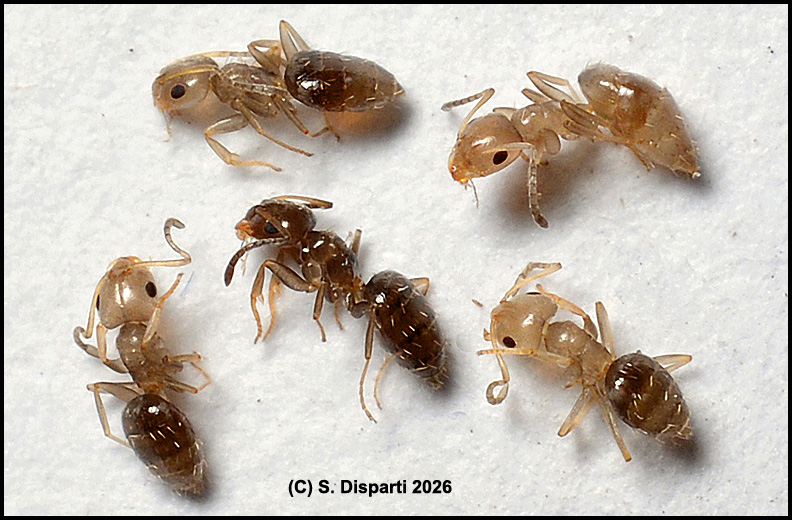
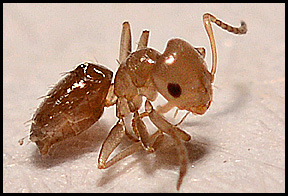
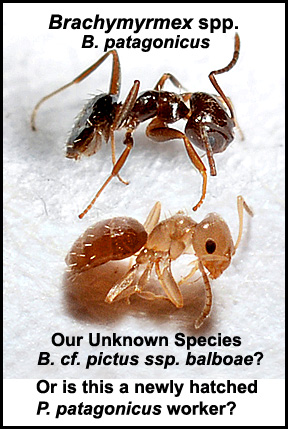
| Mature rover ant worker (Brachymyrmex patagonicus) surrounded by 4 newly hatched callow workers. Depending on camera, settings, and lighting, a small change in color balance can shift color of head & thorax to yellow-amber like some of our earlier photos. In addition, our original image was from callow worker discovered in container of alcohol. This is why our previous hypotheses (Part II) suggested that we had a different, unreported species of Brachymyrmex. |

| Our Original Introduction: Following Hypotheses Regarding ID of This Ant Are Superseded by Above Paragraphs in Part I. Introduced ant species arrive regularly in San Diego County. In fact, a number of unusual tropical species have been found in pitfall traps placed on bridle path of Twin Oaks Valley, San Diego County, undoubtedly from nearby nurseries receiving daily truckloads of potted plants. See following links to Ants of Twin Oaks Valley (Parts 1 & 2). This latest discovery of an amber-colored South American rover ant needs more research, including location of nest and collection of specimens for confirmation. In our opinion, it fits at least 2 species in dichotomous key of Claudia M. Ortiz-Sepulveda, et al. (2019) discussed below. We are using the cf. designation (compare with) because there are several very similar South American species discussed by Ortiz-Sepulvida, et al. |
|
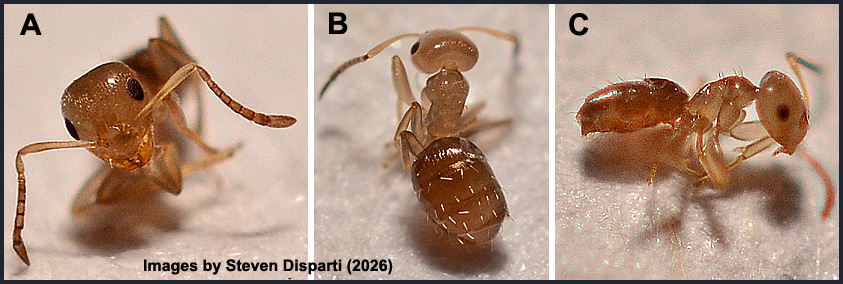
The 3 views in above Image are from a single specimen discovered by Steve Disparti in South Escondido. It was inadvertently collected in container of alcohol with another ant species. We never found the actual nest or colony; however, we are certain it is a Brachymyrmex species with 9 antennal segments. Our images indicate that it may be B. aphidicola or B. pictus based on interpretation of Claudia M. Ortiz-Sepulvida, et al. key. Several species of Brachymyrmex are known from southern California including the dark brown B. patagonicus and the amber-colored B. depilis. Although the body color of latter species is similar to recent Disparti discovery, it is morphologically quite different. They are commonly referred to as rover ants, and are among the smallest ants in our area with body lengths just over one millimeter. AntWiki has some interesting details & observations about the CA amber-colored rover ant Brachymyrmex depilis. Unlike recent Disparti discovery, B. depilis lacks erect hairs on mesosoma & mesonotum, and is bulging dorsally above pronotum. In addition, B. depilis has much smaller compound eyes. Several details in above Image (C) point to B. aphidicola, especially 2 faint erect hairs on pronotum & mesonotum.
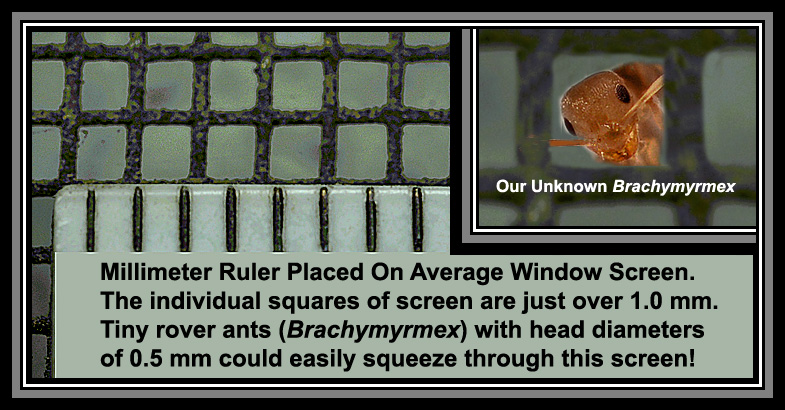
Gee Whiz Note: According to AI, the square openings in standard insect-proof window screens are roughly 1.4 to 1.6 mm (1/16 of an inch). This is about the length of some minute Brachymyrmex worker ants. I.e. They could squeeze through screens with this mesh dimension! |
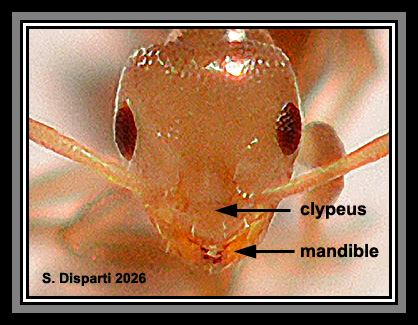 |
Left image & our specimen matches AntWiki Key to Brachymyrmex (Couplet 1 Fig. a1) with row of hairs near anterior margin of clypeus. This choice leads to B. aphidicola. It clearly has more than 6 ommatidia along maximal diameter of compound eye. Length of scape in relation to compound eye also matches AntWiki Key & Ortiz-Sepulvida descriptions. |
|
References About Taxonomy of Brachymyrmex Species:
1. AntWiki: Key To U.S. Brachymyrmex Species:
2. AntWiki: Key To Brachymyrmex Species:
3. Claudia M. Ortiz-Sepulveda, et al:
|
|
In Ortiz-Sepulveda, et al. key, the following choices lead to Brachymyrmex aphidicola. |
|
1 Go To 2 2 Go To 5 5 Go To 6 6 Go To 9 9 Go To 11 11 Go To 13 13 Go To 15 15 Go To 17 17 Go To 28 28 Go To 29 29 Go To 30 30 Go To 31 31 Go To 32 32 (1st Choice) B. aphidicola |
|
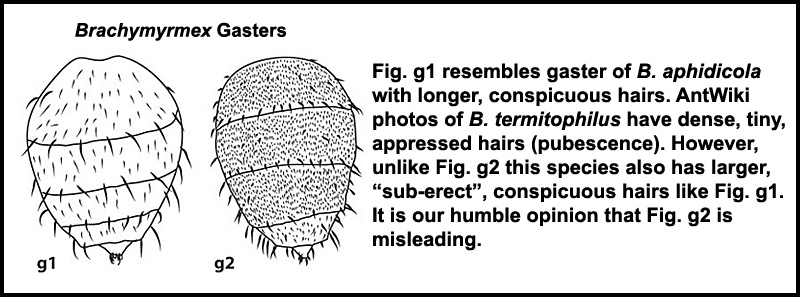
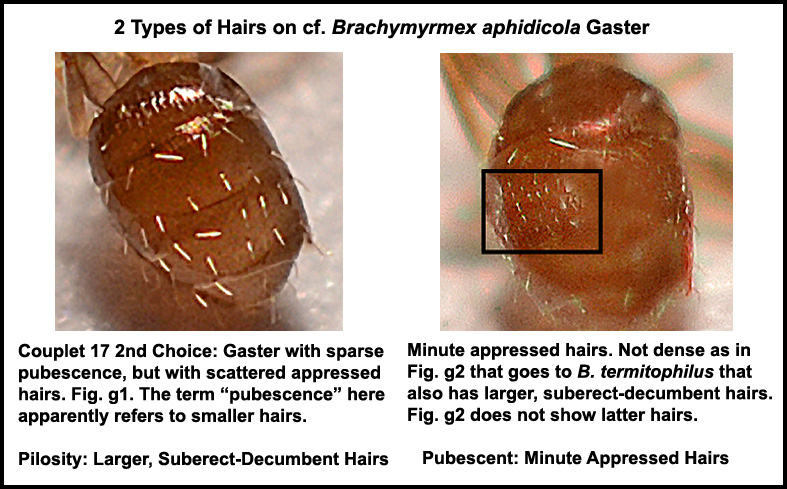
As I stated above, there are several look-alike, amber-colored ants in the Ortiz-Sepulveda, et al. key: "Brachymyrmex aphidicola is morphologically similar to B. australis, B. minutus, and B. termitophilus, because all of them typically have smooth and shiny yellowish bodies, their mesonotum does not bulge dorsally above the pronotum, their eyes are positioned on the cephalic midline, and the metanotal groove is either absent or narrower than diameter of the metathoracic spiracles. However, B. aphidicola differs from B. australis by having scapes that surpass the posterior margin of the head by a length longer than the maximal diameter of the eye; from B. minutus by having a well-differentiated mesometanotal suture and by the presence of two erect hairs on the pronotum and two on the mesonotum; and from B. termitophilus by having scattered pubescence (not dense pubescence) on gaster." With regard to the separation of B. aphidicola & B. termitophilus, the most confusing couplet is #17 scattered vs. dense pubescence on gaster: "Gaster with dense appressed or decumbent pubescence (Fig. g2)" and "gaster with sparse pubescence, but with scattered, appressed hairs (Fig. g1)." There are apparently 2 types of hairs on gaster: Minute appressed hairs, and longer, conspicuous, suberect-decumbent hairs. Assuming the couplet is referring to the minute appressed hairs, difficult to see without sufficient magnification, they do not appear dense in our specimen, unless our magnification is insufficient. See following illustration used in key. |
|
In ant morphology, it is important not to confuse pubescence with pilosity: Pubescence: Composed of soft, microscopic, appressed hairs that lay flat against the body. Often, it gives the cuticle a matte, satiny, or metallic sheen. Problem: Is magnification sufficient in above photo to determine whether pubescence (minute appressed hairs) is dense or scattered> Pilosity: Refers to the longer, stiffer, and erect to suberect hairs that project outward from the body. These hairs are shown abobe in left image.
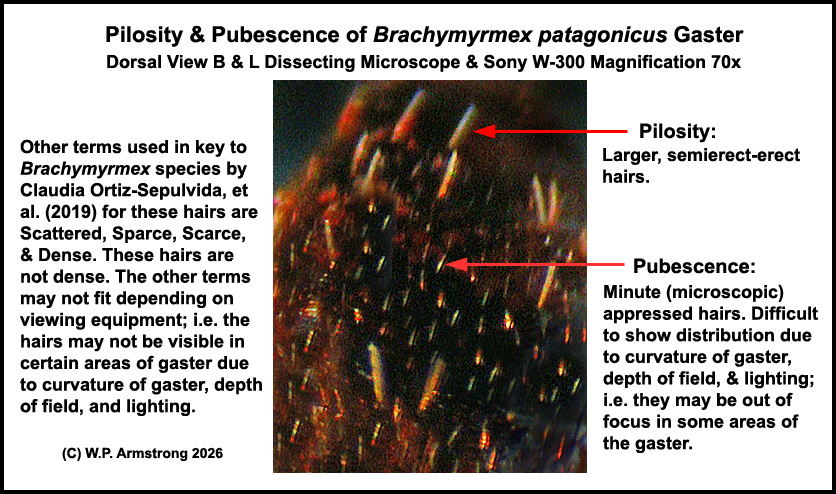
Hairiness Terms That Don't Exactly Match Microscope Image
AntWiki Morphological Terms For Ant Hairiness:
In Botany the word "pubescence" is a broad term that applies to any type of plant
hairiness. The following are a few examples placed on Wayne's Word Website. |
|
1. Arachnoid: Cobwebby--soft, entangled hairs. 2. Barbellate: Hairs with barbs down the sides. 3. Bearded: Long, stiff hairs. 4. Bristly: Stiff hairs. 5. Canescent: Dense grayish-white hairs. 6. Ciliate: Hairs along leaf margin forming a fringe. 7. Floccose: Tufts of soft, woolly hairs. 8. Glandular: Hairs with enlarged gland at tip. 9. Stiff hairs, rough to the touch. 10. Hispid: Stiff (rigid), bristly hairs--may penetrate skin. 11. Hoary: Covered with short fine hairs (white down). 12. Lanate: Woolly or cottony hairs. 13. Pilose: Sparse, soft and straight hairs. 14. Puberlulent: Minutely pubescent (diminutive of pubescent). 15. Scabrous: Rough to the touch due to short, stiff hairs. 16. Sericeous: Appressed, fine and straight hairs (silky). 17. Stellate: Star-shaped hairs (common in Malvaceae). 18. Strigose: Sharp, straight, appressed hairs. 19. Tomentose: Densely matted, soft white wool (tomentum). 20. Villous: Long and soft hairs (shaggy)--not matted. 21. Woolly: Long, soft entangled hairs (similar to tomentose). |
| Wayne's Word Leaf Terminology Page 2 |

 Return To WAYNE'S WORD Home PageReturn To NOTEWORTHY PLANTS PageGo To Biology GEE WHIZ TRIVIA PageGo To The
LEMNACEAE ON-LINE Page Return To WAYNE'S WORD Home PageReturn To NOTEWORTHY PLANTS PageGo To Biology GEE WHIZ TRIVIA PageGo To The
LEMNACEAE ON-LINE Page
|